Where to Automate First: A Simple Framework for Growing Businesses
|
5
min read
Every growing business eventually hits the same wall: there's more work than there is time, and hiring another person for every gap isn't sustainable. Automation and AI get pitched as the answer, and they can be. But most businesses automate the wrong things first, and end up with a faster version of a broken process instead of a genuinely better one.
Before you touch a single tool, it helps to know where automation actually pays off, and where it quietly makes things worse.
Automate the process, not the chaos
If a task is inconsistent, undocumented, or handled a different way by every team member, automating it just locks in the inconsistency at higher speed. Automation works best on processes that are already clear and repeatable, even if they're currently done manually. If you can't describe the steps precisely, it's not ready to automate. It's ready to be documented first.
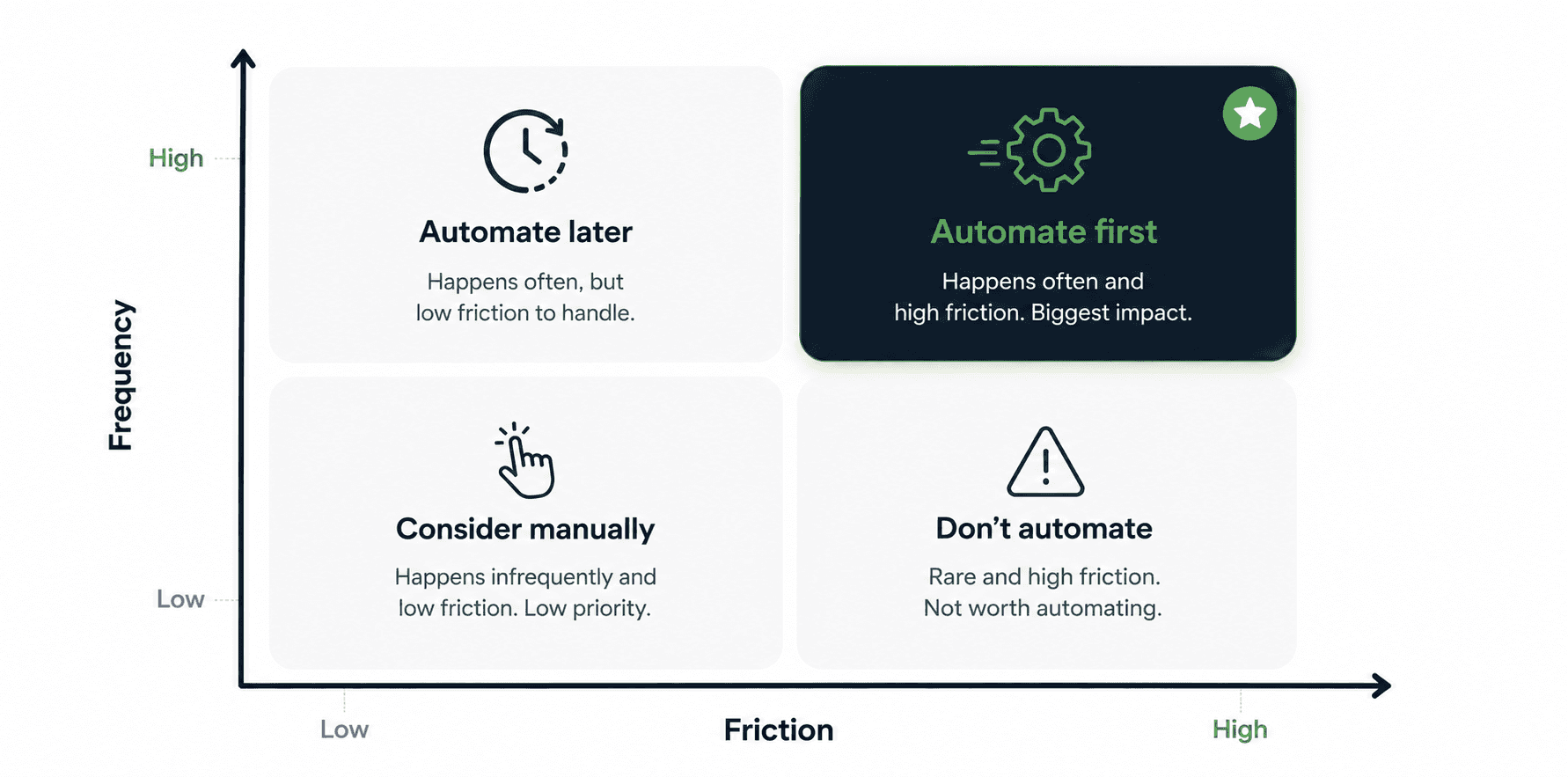
A simple framework: Frequency × Friction
You don't need a complicated scoring model. Two questions get you most of the way there:
How often does this happen? Daily and weekly tasks are worth far more automation effort than something you do twice a year.
How much friction does it cause? Friction shows up as time spent, errors made, or how much someone dreads doing it.
The best first candidates sit at the intersection: high frequency, high friction. Think of things like:
Manually re-entering the same customer data across two systems
Sending the same follow-up emails or reminders by hand
Compiling a weekly or monthly report from three different spreadsheets
Routing incoming leads or support tickets to the right person manually
Chasing signatures, approvals, or missing information on a repeating basis
Where AI fits in, and where it doesn't (yet)
Automation and AI aren't the same thing, even though they're often lumped together.
Automation is best for rules-based, repetitive tasks with clear steps: if this happens, do that. Think workflow triggers, data syncing, scheduled reports.
AI is best for tasks involving judgment, language, or unstructured information: summarizing a long email thread, drafting a first-pass response, categorizing open-ended customer feedback, or pulling key details out of a messy document.
A good rule of thumb: if you could write the exact steps in a flowchart, automate it. If you'd need to explain judgment calls to get it right, that's where AI-assisted work, not full automation, tends to add the most value.
The mistake to avoid
The most common automation failure isn't a broken tool. It's automating a process nobody agreed on, built by one person, understood by no one else, that quietly breaks the moment something changes upstream, and nobody notices for weeks because it used to be a human doing the noticing.
Before you automate anything customer-facing or financially significant, make sure at least one other person on your team understands exactly what it does and why.
Starting small, on purpose
You don't need an "automation strategy" before you get value from automation. Pick one high-frequency, high-friction task. Document how it works today. Automate that one thing. Confirm it's actually working as expected for a few weeks. Then move to the next.
Done this way, automation and AI stop being a big scary transformation project, and start being a habit of quietly removing friction, one repeatable task at a time.
Share It On:
Join my newsletter for practical lessons on business operations, CRM, systems, and automation.


